Introduced in 1968, the Marantz Model 18 was a groundbreaking stereo FM receiver that marked a pivotal moment in audio history. At the time, Marantz was transitioning from its founder, Saul Marantz, to new ownership under Superscope, which aimed to broaden the brand’s appeal. The Model 18 was Saul’s final contribution before his departure, blending the company’s legacy of high-end separates into its first all-in-one receiver. Priced at $695 it was a luxury item, yet it sold over 7,000 units by 1969, proving its appeal. Designed by engineering legends like Sidney Smith and Richard Sequerra, the Model 18 became a symbol of Marantz’s innovation during the shift from tubes to transistors.
Design
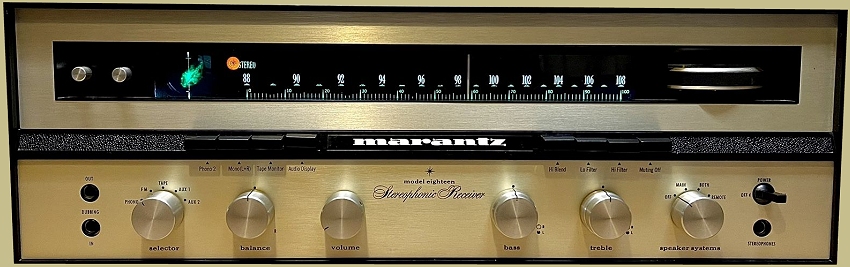
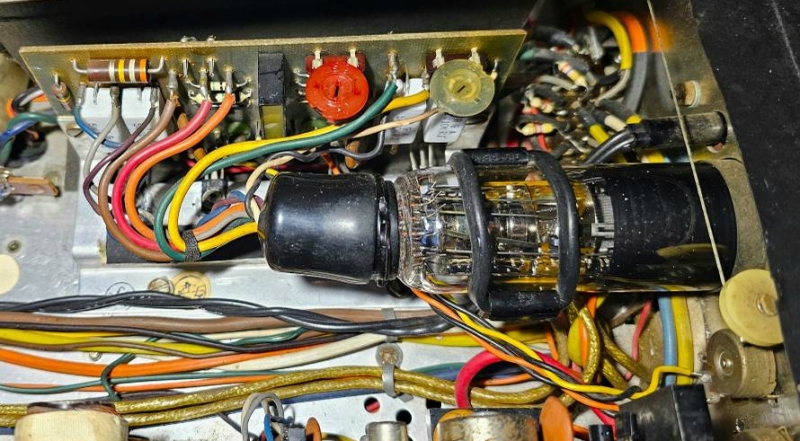
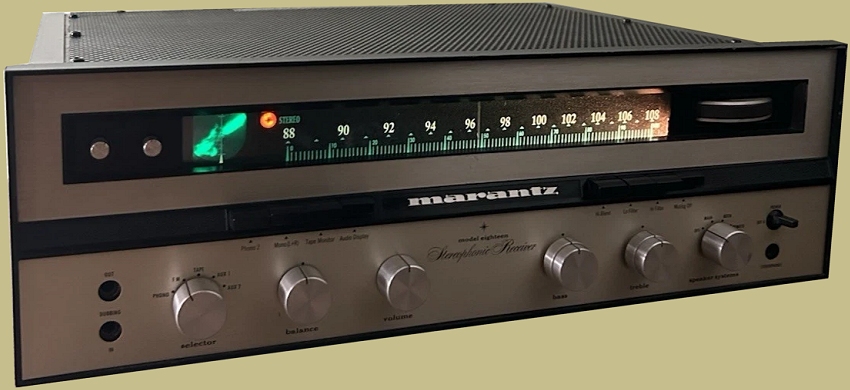
The Model 18 wasn’t just a receiver – it was a statement. Its sleek black-and-gold front panel featured a striking horizontal “Gyro-Touch” tuning knob, which was actually the flywheel of the tuning mechanism. This silky-smooth control made station selection feel precise and satisfying. A beautiful optional walnut cabinet was available at a cost of $39.50. The showstopper was the built-in oscilloscope, a small cathode-ray tube (CRT) that doubled as a tuning aid and audio diagnostic tool.
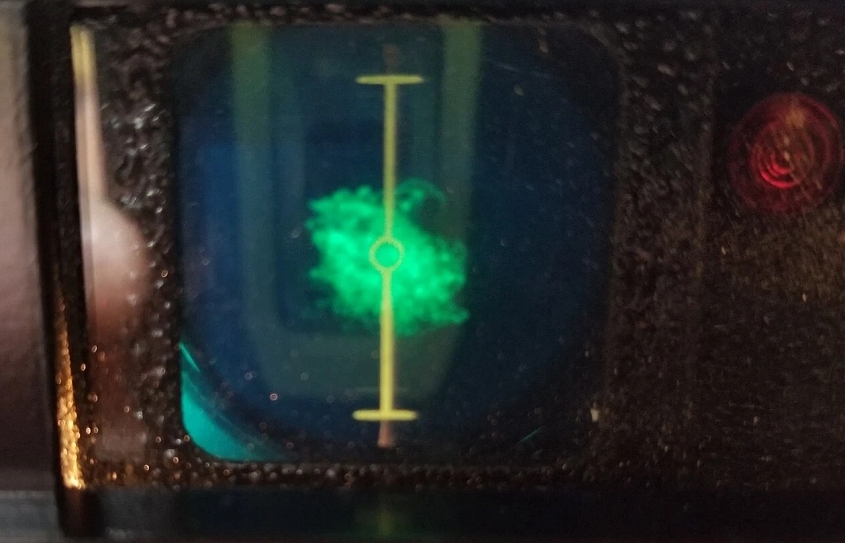
This quirky feature let you:
- Visually align your antenna to eliminate signal distortion.
- Confirm whether a station was broadcasting in stereo.
- Check for audio phase issues or channel imbalances.
Beyond the ’scope, the Model 18 was packed with thoughtful details:
- Dual tape inputs (front and rear) for easy dubbing between two recorders.
- Separate bass/treble controls for each channel, a rarity at the time.
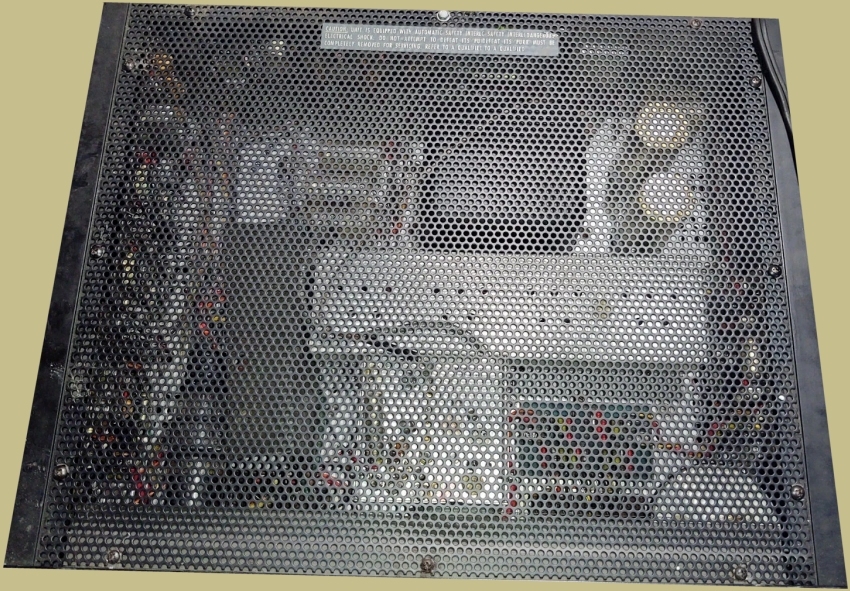
- Quality construction: heavy metal chassis, cooling fins, and meticulous wiring.
- Flexibility: connections for two turntables, two speaker sets, headphones, as well as auxiliary inputs.
Marantz didn’t cut corners. Even the FM tuner borrowed radar technology (a passive front end) to avoid overload from strong signals, while advanced filters ensured crisp, interference-free reception.
Front Panel
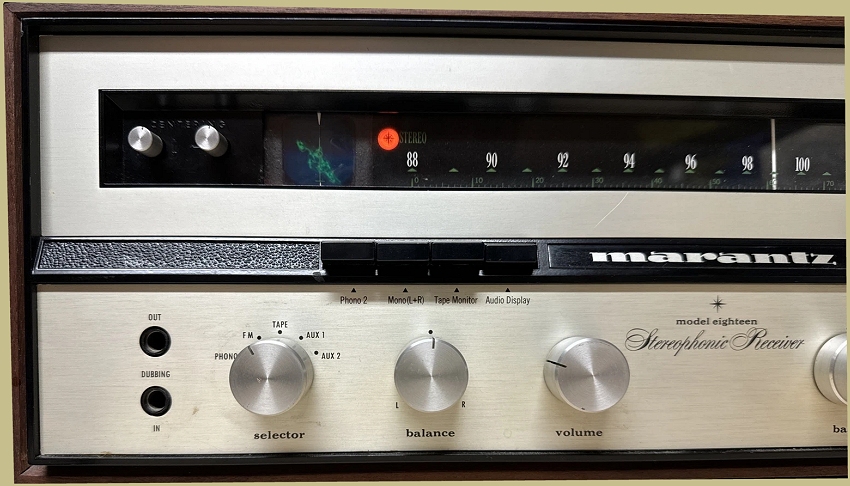
The FM dial on the Model 18 is 8 1/2 inches wide, and the station numerals are supplemented with a logging scale. A red stereo indicator lamp comes on whenever you tune to a station broadcasting in stereo. Here’s a breakdown of the front panel controls on the Marantz Model 18:
Gyro-Touch Tuning Knob: A large, knurled flywheel knob for smooth FM tuning. Its horizontal orientation and weighted feel made precise station selection effortless.
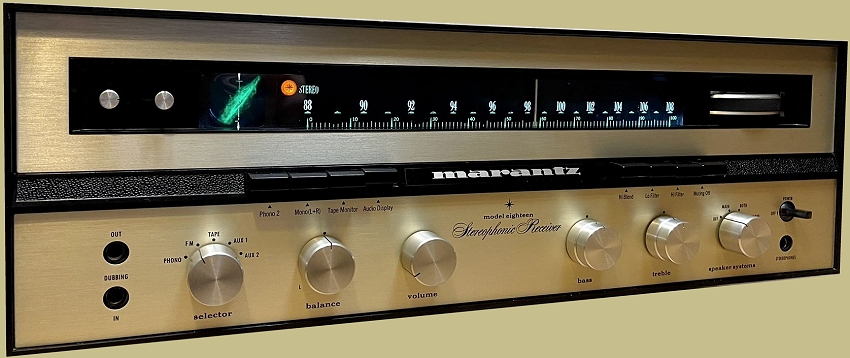
Program Selector Knob: Selects input sources: Phono, FM, Tape, Aux 1, Aux 2.
Channel Balance Knob: Adjusts the balance between left and right speakers.
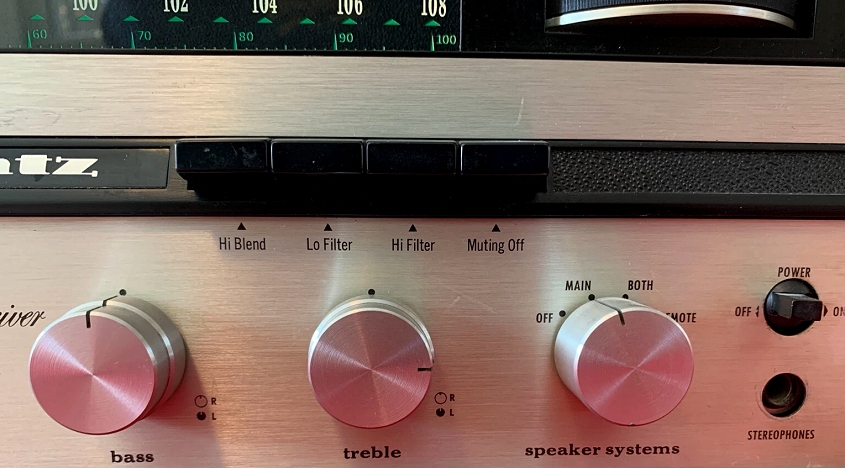
Dual Concentric Bass/Treble Knobs: Outer rings adjust bass/treble for both channels. Inner knobs fine-tune bass/treble for individual channels.
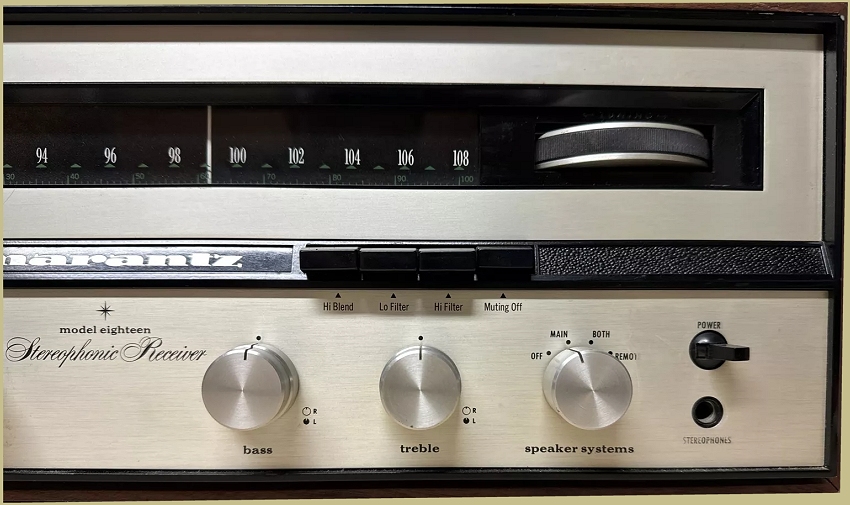
Speaker Selector Knob: Chooses speaker outputs: Off, Main, Both, Remote.
There is a row of push buttons below the dial for:
- Second phono input
- Mono conversion
- Tape monitor
- Audio display (oscilloscope mode)
- High blend (reduces stereo separation in highs to cut noise)
- Low/high filters (cuts bass/treble)
- Muting off
- Stereo Headphone Jack: located to the right of the speaker selector knob. Unlike many vintage receivers, it’s always active, even when speakers are turned off.
Performance
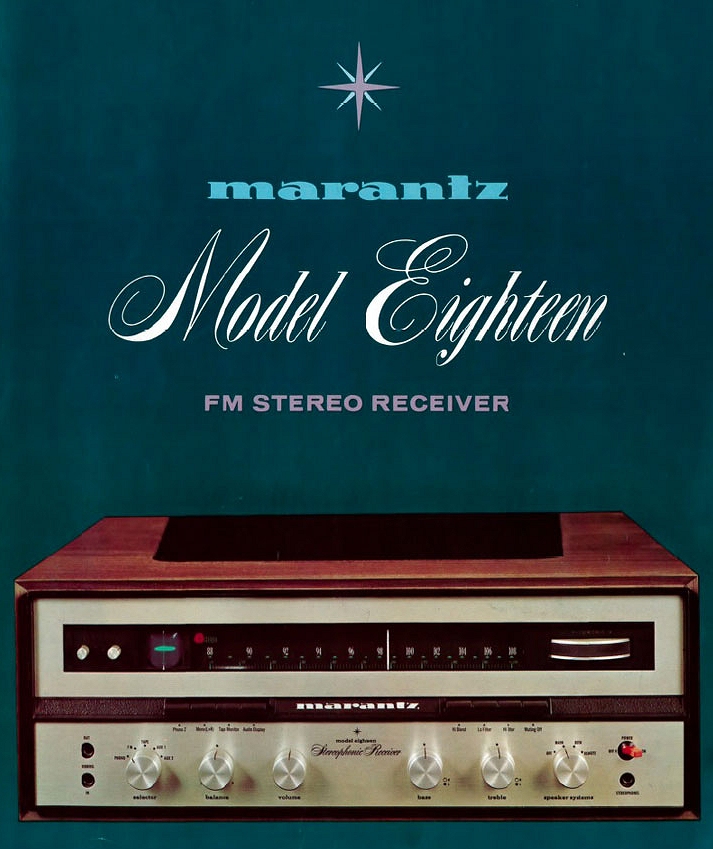
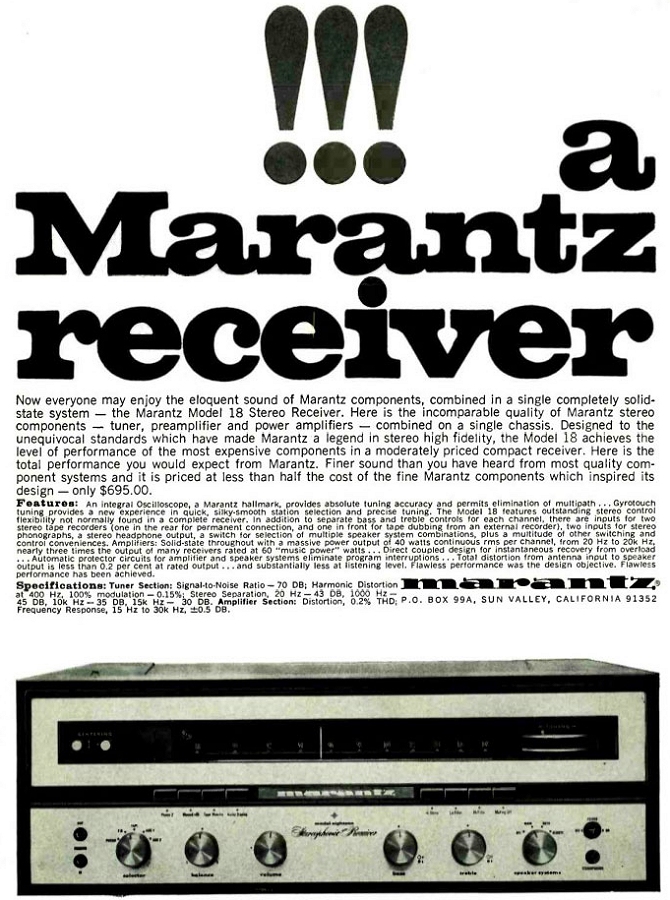
The Marantz Model 18 was famously understated about its power. Officially rated at 40 watts per channel, it actually delivered nearly double that (up to 78 watts) when pushed, with distortion so low it was often immeasurable. Critics praised its “clean,” “distortion-less” sound, comparing it favorably to Marantz’s own separates. The tuner, meanwhile, was a revelation—its oscilloscope helped users optimize reception in real time, while specs like 45 dB stereo separation and precise RIAA equalization for vinyl made it desirable to audiophiles.
Tone Controls
The Marantz Model 18’s tone controls were unusually advanced for their time, offering dual concentric knobs for bass and treble adjustments. Here’s the breakdown:
- Dual Concentric Design:
Each tone control (bass and treble) consisted of two stacked knobs. The outer ring adjusted both channels together, while the inner knob could fine-tune each channel individually. This allowed precise balancing of left/right speaker output – ideal for correcting room acoustics or channel imbalances. - Flexible Adjustment Range:
The bass and treble controls had a wide, smooth sweep (±12 dB or more) with center detents for flat response. In testing, the frequency response stayed within ±1 dB of neutrality when set flat.
Most vintage receivers only offered global tone adjustments. The Model 18’s per-channel control was rare, giving audiophiles studio-grade flexibility to tailor soundstage depth, correct uneven recordings, or compensate for speaker placement
Repair
While the Model 18 was exceptionally well built it’s still well over 50 years old and many will need maintenance at a minimum. Fortunately there are rebuild kits available on eBay:

You can also find lamp kits for the Model 18:
FM Tuner
The Marantz Model 18’s FM tuner was a standout feature, even among high-end receivers of its era, and it incorporated several advanced technical innovations that set it apart. Here’s a breakdown of its design and performance:
Passive Front-End Design:
- Unlike most tuners of the time, the Model 18’s FM tuner used a passive front-end with no RF amplifier stage. Instead, it employed a balanced diode mixer borrowed from radar technology. This design prioritized dynamic range over raw sensitivity, minimizing cross-modulation and overload from strong nearby stations.
- Sensitivity: Rated at 2.8 µV (IHF), it was modest on paper but compensated with exceptional limiting action (near-complete limiting at 5 µV), ensuring clean reception even on weaker signals.
IF Section with Modified Butterworth Filters:
- The intermediate frequency (IF) stage used modified Butterworth filters instead of conventional IF transformers. These filters provided linear phase response and steep skirt selectivity (sharp cutoff), which improved adjacent channel rejection (critical in crowded FM markets) and stereo separation at high frequencies (flat to 10 kHz, down only 1.5 dB at 15 kHz).
Multiplex Decoding & Noise Reduction:
- A 19 kHz crystal oscillator ensured stable stereo decoding with 45 dB channel separation at mid-frequencies.
- A built-in low-pass filter in the multiplex section effectively suppressed residual 19 kHz/38 kHz pilot and subcarrier signals, eliminating audible artifacts.
Oscilloscope Tuning Aid (CRT):The tuner’s cathode-ray tube (CRT) oscilloscope was revolutionary. It displayed:
– Signal strength (vertical position on a logarithmic scale).
– Modulation width (horizontal line length).
– Multipath distortion (ripples in the line), which users could minimize by adjusting their antenna.
– Stereo vs. mono status (a 45° diagonal line indicated mono; stereo showed dual traces).
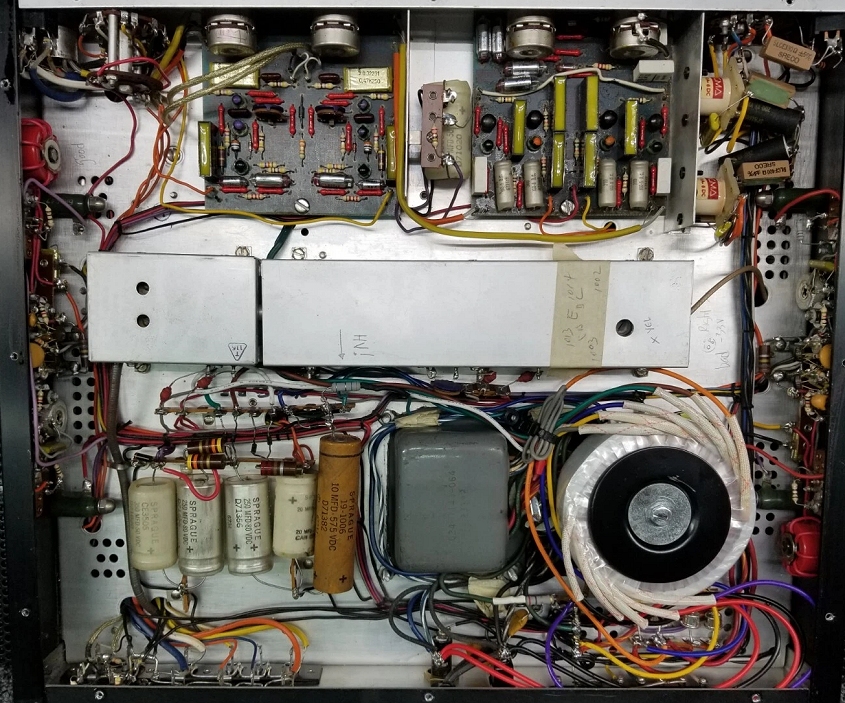
Photo-Resistor Switching:
- Marantz used light-dependent resistors (LDRs) for muting and stereo/mono switching. This eliminated the “thumps” or “clicks” typical of relay-based switching systems.
Performance:
- Distortion: Just 0.5% THD at 100% modulation (close to the test equipment’s own residual noise), with near-undetectable distortion at typical listening levels.
- Selectivity: The Butterworth filters’ steep skirts allowed the tuner to reject adjacent stations effectively, even in dense urban environments.
- Real-World Use: The oscilloscope wasn’t just a gimmick—it let users visually optimize antenna placement to combat multipath interference, a common FM reception issue.
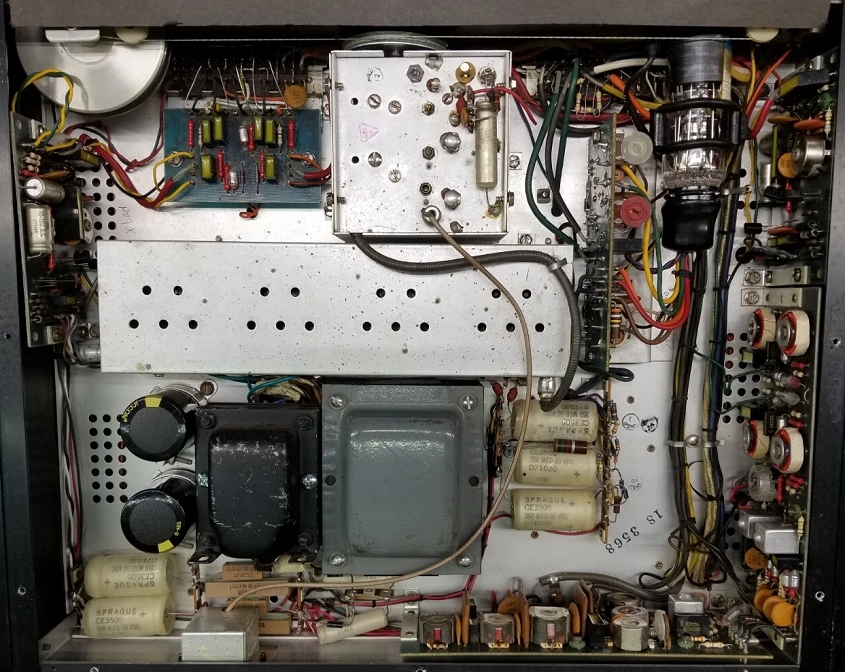
The Model 18’s tuner was overengineered and was a masterclass in analog FM tuner design for its time.
Rear Panel
The rear panel on the Marantz Model 18 includes:
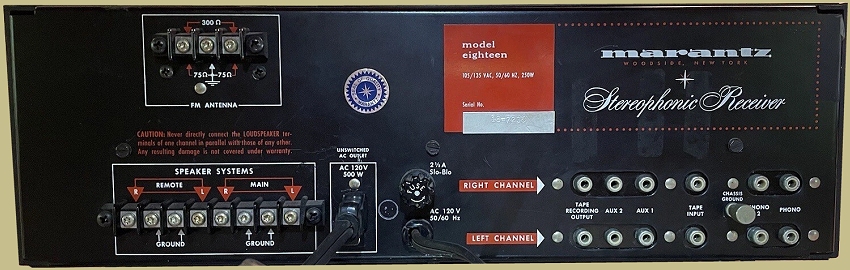
Antenna Terminals: 75-ohm (coaxial) and 300-ohm (flat wire) FM antenna inputs for optimal signal reception.
Phono Inputs: Two magnetic phono inputs (for turntables with moving magnet or high-output cartridges).
Tape Connections: Tape In/Out RCA jacks for recording and playback, supporting tape monitoring (useful for 3-head tape decks).
Auxiliary Inputs: Aux 1 & Aux 2 RCA jacks for high-level external sources (e.g., TV, CD player, or additional tuner).
Speaker Terminals: Two sets of stereo speaker outputs (Main and Remote), allowing simultaneous use of two speaker pairs.
AC Outlet: A single unswitched AC outlet (always live) for powering external devices like a turntable or tape deck.
Grounding Post: A screw terminal to ground the turntable and reduce hum/interference.
Conclusion
The Model 18 is a timeless piece of audio craftsmanship. Over 50 years later, many units still work well, thanks to premium components and overbuilt engineering. Most could definitely use a recap for optimal performance though. It looks great and the oscilloscope gives it an extremely cool, attention grabbing, retro look. As far as performance goes it is known for its warm, detailed sound quality while still being powerful enough for most modern speakers.
The Marantz Model 18 is more than a receiver, it’s a bridge between the golden age of hi-fi and the transistor era. Whether you’re a collector, a vinyl lover, or someone who appreciates analog ingenuity, the Model 18 offers a rare mix of nostalgia, performance, and sheer cool factor. It’s a reminder that great design never goes out of style.