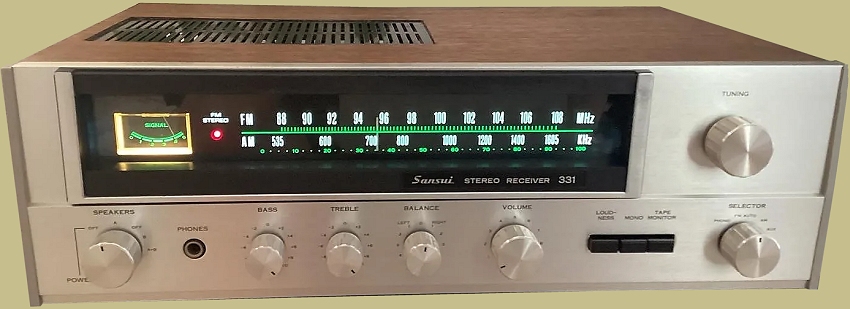
The Sansui Model 331 entered the market as an affordable stereo receiver, priced around $200. It delivers 12 watts per channel and has only basic features. It was produced from 1975 to 1977. Don’t let the modest specs fool you though. The Sansui 331 is a bit of a hidden gem. It punches well above its weight, delivering a sound that’s way more impressive than you’d expect from a 12-watt unit. The FM tuner is surprisingly crisp, and the whole thing just feels good in a way that makes you appreciate vintage audio gear. It’s one of those components that proves you don’t always need to spend big to get great sound.
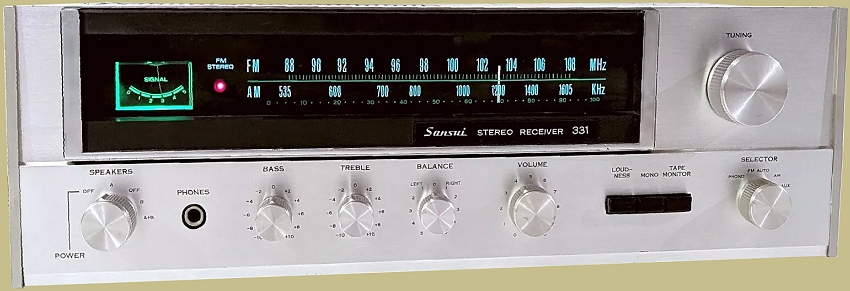
Aesthetically, the 331 looks great. The front panel is brushed aluminum. The inset dial face extends about two thirds of the way across the front panel and has a black background. The dial scale is backlit in green and the station numbers in white. Overall, it has a very appealing color combination.
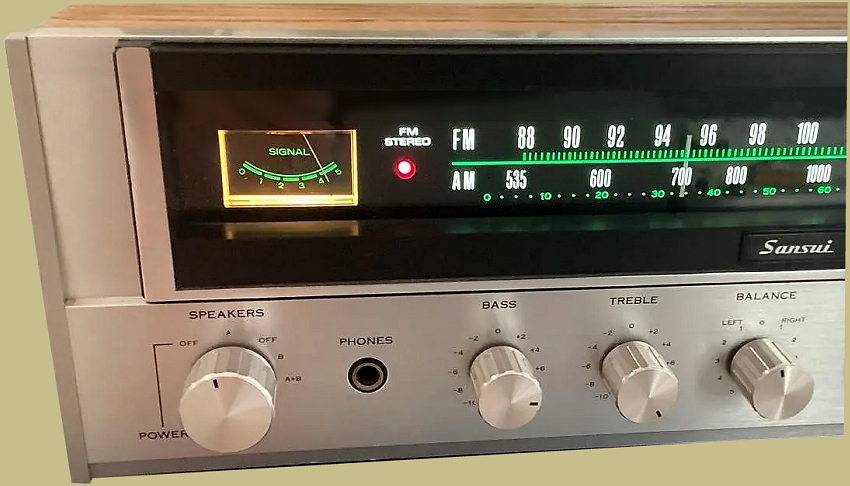
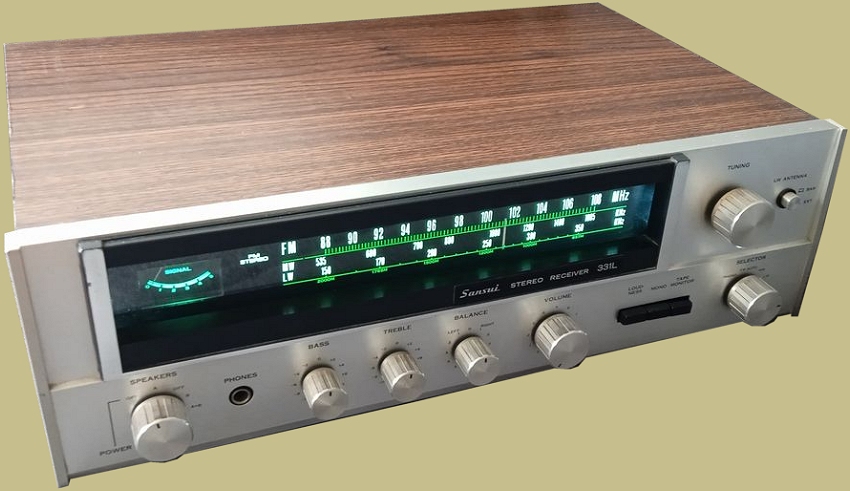
Front Panel
The front panel on the Sansui 331 is pretty straightforward. There are controls for volume, balance, bass, and treble. The speaker selector switch doubles as the power switch. You can also disable both speaker sets to listen to headphones. There are three push buttons that control Loudness, Mono, and the Tape Monitor. A signal strength meter sits at the top left corner.
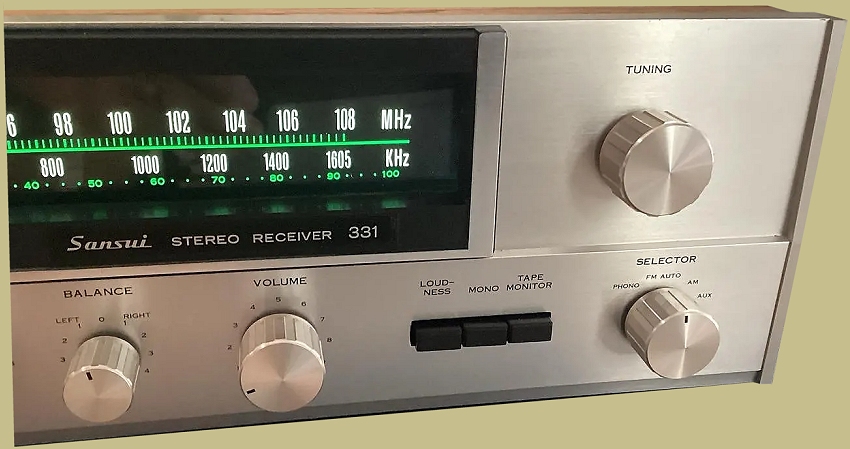
The bass tone control provides a ±12 dB adjustment at 50 Hz, while the treble control offers a ±10 dB range at 10,000 Hz. The loudness compensation switch automatically boosts both high and low frequencies when listening at lower volume levels.
Tuner
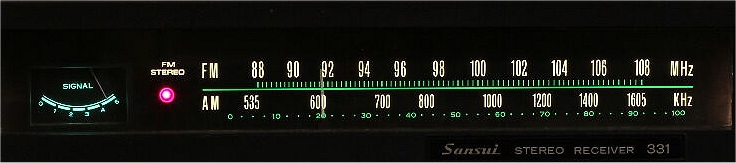
Despite being a budget receiver the 331 has an excellent tuner. A heavy sintered alloy flywheel makes dialing in stations smooth and precise. The FM frontend has a precision-finished, frequency-linear variable capacitor and a low noise MOS FET to improve sensitivity to even the faintest of FM signals while raising the signal-to-noise ratio. Two bi-resonator ceramic filters and high-density ICs make for pinpoint FM Station selection even in FM congested areas.
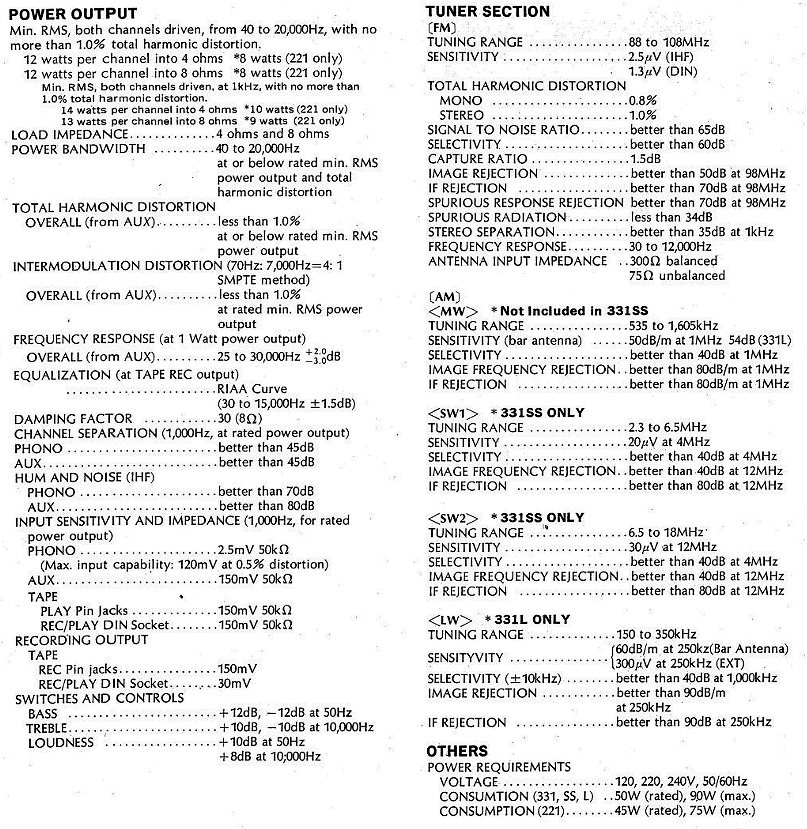
With an IHF sensitivity of 2.5 microvolts, the receiver can capture weak radio signals with precision. Its capture ratio of 1.5 dB gives it the ability to distinguish between closely spaced broadcast frequencies.
The receiver’s selectivity and rejection metrics are really good as well. Alternate channel selectivity exceeds 60 dB, meaning it effectively filters out adjacent radio station interference. Image rejection stands at over 50 dB, while intermediate frequency (i.f.) and spurious response rejection both surpass 70 dB. This gives you a clean, interference-free signal.
The signal-to-noise ratio for FM reaches more than 65 dB, and stereo separation extends beyond 35 dB at 1,000 Hz. Harmonic distortion is minimal—less than 0.8% in mono mode and under 1% in stereo giving it good clarity and fidelity.
Specifications
- Power output: 12 watts per channel, will drive down to 4Ω
- Frequency response: 25Hz to 30kHz
- Total harmonic distortion: <1%
- Signal to noise ratio: 80dB (line)
- Dimensions: 16 3/4 x 5 x 10 1/2 inches (424 x 125 x 266mm)
- Weight: 12.6 lbs (5.7kg)
Phono Circuit
Sansui went the extra mile with the phono stage on this receiver. They cranked up the negative feedback in a two-stage circuit to seriously clean up the sound – that means lower distortion and a much cleaner signal-to-noise ratio. The RIAA equalization is spot-on, and a constant voltage supply keeps everything running smooth and consistent. It’s good engineering on a constrained budget.
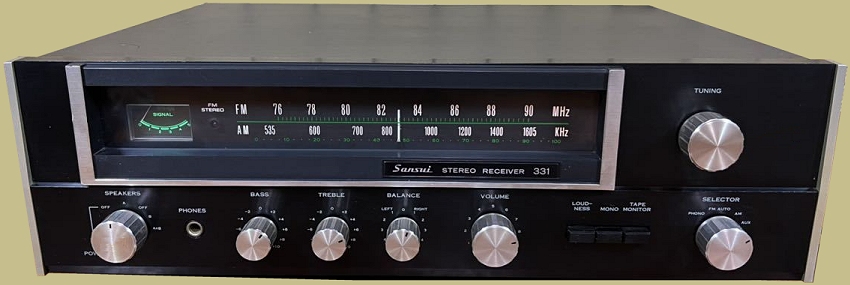
The Model 331 also came with a black faceplate and cabinet. These are somewhat rare but can be found occasionally.
Amplifier
The 331 delivers 12 watts per channel of continuous power, compatible with both 4 and 8 ohm speaker systems. That doesn’t sound like a lot but most users claim that it outperforms those ratings and sounds very good.
It was actually built really well for its price point and the specs show it. Harmonic and intermodulation distortion remain below 1%, which translates to clean, undistorted audio output. The signal-to-noise ratios are particularly noteworthy—over 70 dB for phono inputs and an even more impressive 80 dB for high-level inputs, resulting in minimal background noise.
Vinyl enthusiasts will appreciate the precise phono input design, which matches the RIAA equalization standard within ±1.5 dB. This tight tolerance ensures that recorded music is reproduced with accuracy and minimal deviation from the original recording.
The Sansui 331 isn’t a complex receiver and that is reflected in the simplicity inside the case. Everything is easily accessible and the potentiometers are unobstructed and easy to clean if needed.
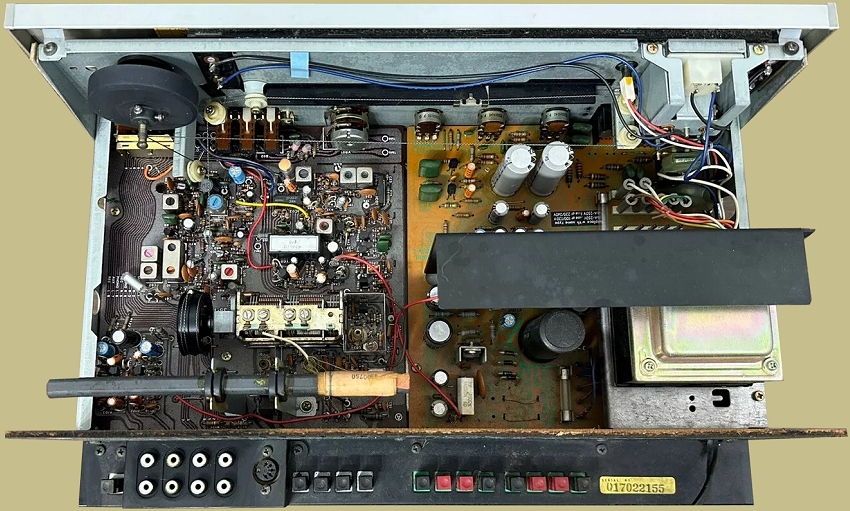
The Model 331 utilizes a semi-complimentary power amplifier for both channels which consists of a hybrid IC with four large power transistors. Also, note the built-in AM bar antenna which helps cut down on noise and allows you to pick up stations more easily.
Reviews
- “Wow! Get one if you can.”
- “Outstanding sound. It has a very sensitive FM tuner and pulls in distant stations. It sounds warm and smooth like a tube amp. An all-day listener with no fatigue.”
- “If you would like to hear what all the vintage audio hype is about on the cheap, the Sansui 331 would be a great choice.”
- “The phono pre-amp is very high quality. This is a fine unit and has many uses for a small area. Nearly bullet proof.”
- “Love this little receiver. Very good sound quality. Nice bass and crystal clear high frequencies. Sounds like a tube amp.”
Rear Panel
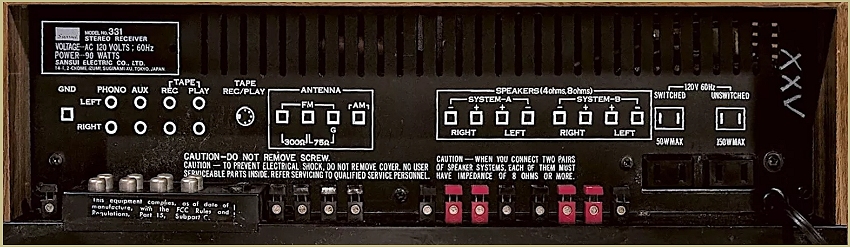
The Model 331 has inputs for external phono and auxiliary sources as well as a tape deck. There are terminals for two sets of speakers and two outlets (one switched and one un-switched). Notice that the inputs/outputs all sit on a ‘shelf’ that extends from the back panel.
Summary
The Sansui 331 is a budget-friendly receiver that delivers good, reliable performance for the average listener. Despite its minimal features, it produces a really nice sound, is easy to use and can be found at a reasonable price. While it may not meet the highest audiophile standards, it’s definitely a solid value for those looking for a dependable, no-frills vintage audio solution. Given its lower power output it would be best paired with efficient speakers. If you need more than what the 331 offers then consider the Sansui 441, 551, 661 or even the top of the line 881.