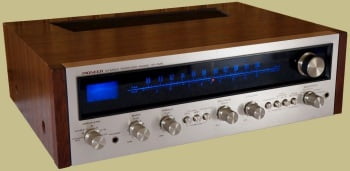
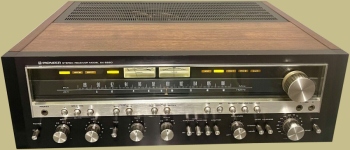
The Pioneer SX-D5000 stands at a crossroads in receiver design, marking the shift from analog to digital technology in the early 1980s. Made between 1980 and 1983, this AM/FM quartz synthesized stereo receiver was among Pioneer’s first steps into the digital realm, which is reflected in the “D” prefix of its model number. Its silver faceplate combined with wood side panels creates an attractive blend of technical and warm aesthetic elements.
The SX-D5000 breaks away from traditional receiver design with its modern control layout. Instead of the usual array of knobs and levers, it primarily uses pushbuttons and sliders, keeping only the volume and balance as exceptions. All displays, including the tuning frequency, are digital, giving the unit a more technical, precision-instrument appearance. The controls are neatly arranged in three sections: tone adjustments on the left, main controls in the center, and tuning functions on the right.
Under the hood, the SX-D5000 delivers solid performance with 80 watts per channel through its non-switching amplifier, maintaining very low distortion rates of less than 0.005%. The receiver features Pioneer’s “Station Call” function that stores up to six preset stations—a notable advancement for its time.

The SX-D5000 is a substantial piece of equipment, weighing in at 39 pounds. It was one of the last full-sized receivers from Pioneer and while its build quality is not quite as robust as earlier Pioneer models, its performance specifications are still impressive. When released, the SX-D5000 was priced at $600, while its more powerful sibling, the SX-D7000, went for $800.
These transitional models are now relatively hard to find, as they weren’t produced in large numbers and had front panels that were prone to damage. Finding one in good cosmetic condition has become something of a challenge, which adds to their appeal for vintage audio enthusiasts and collectors.

Front Panel
The front panel of the SX-D5000 features a thoughtfully organized layout divided into three main sections: tone, control, and tuning. This arrangement makes the receiver both functional and intuitive to use.
In the tone section, you’ll find Bass and Treble slider controls, each with 11 click stops that allow precise sound adjustment without adding audible distortion. These controls are part of Pioneer’s Low-Distortion Tone Control Amp, an IC-built circuit that uses negative feedback to keep distortion remarkably low—0.005% or less at 4V output across the entire audible frequency range. When these sliders are centered at the “0” position, the tone amp is completely bypassed, providing a flat response at the output.
The control section includes a Speaker switch for managing two sets of speakers, with LED indicators showing which set is active. There’s also a Low (Subsonic) Filter switch that operates at 18Hz with a -6dB/octave curve to eliminate unwanted ultra-low frequencies. Tape enthusiasts will appreciate the Tape Monitor and Duplicate switches for two tape decks, making deck-to-deck dubbing easy in either direction.
Additional controls include Loudness, Balance, Mode (Stereo/Mono), and Muting (-20dB) functions. An Adaptor switch allows you to connect signal processors like graphic equalizers, dynamic processors, or reverberation units.

The center of the front panel houses Pioneer’s “Light Touch” buttons for selecting input sources (FM/AM/AUX/PHONO). These buttons glow green when engaged, providing a clear visual indication of the active source.
The master Volume Control is an attenuator-type knob with decibel calibrations from 0 down to -70dB and features 41 detents for precise adjustment. This calibration lets you quickly gauge how much power the receiver is delivering, which is reflected on the FLUROSCAN power meter.
Speaking of which, the FLUROSCAN Power Output Meter replaces the traditional needle-type analog meters common at the time. Each channel’s bar-graph display consists of 12 separate fluorescent segments, creating a large, clearly-calibrated display that’s easier to read than conventional VU-type meters. The meter shows power output from 0.01 to 80 watts, referenced to an 8-ohm speaker load.

Tuner
The tuner section of the SX-D5000 represents some of the most advanced radio technology available in the early 1980s, combining precision engineering with user-friendly features.
At the heart of the tuner is a Quartz-PLL (Phase-Locked Loop) synthesizer that addresses common reception problems like hiss, distortion, and frequency drift. Using a quartz crystal as an accurate controller for the local-oscillator frequency, the system compares the crystal’s steady frequency with the desired station frequency thousands of times per second, ensuring drift-free, precise tuning. This reliable performance is enhanced by two microelectronic C-MOS LSIs (Complementary Metal-Oxide Semiconductor Large-Scale Integrated Circuits) that enable features like AutoScan, Memory, and “Last Call.”
Instead of conventional mechanical tuning capacitors, the SX-D5000 employs electronic varicaps (variable-capacitance diodes) for both FM and AM tuning. These components operate purely electronically, preventing degradation of specifications over time and allowing for preset station memory. The tuner also uses a Field Effect Transistor (FET) as the RF amplifier for higher sensitivity, better interference rejection, and improved resistance to overload.

The IF (Intermediate Frequency) section features three special 2-pole ceramic filters with flat group-delay response to reduce distortion. Two custom-designed Pioneer integrated circuits further enhance performance: the PA-3007A serves as an FM IF amp/detector to improve signal-to-noise ratio (an impressive 82dB), reduce distortion, and eliminate TV interference, while the PA-4006A contains a PLL stereo demodulator for cleaner, more accurate FM stereo listening and doubles as an automatic pilot signal canceller.
Pioneer’s air-core quadrature discriminator combines a micro-inductor and detection transformer in a single package, delivering higher signal-to-noise ratio, wider channel separation, extended frequency response, and more natural sound quality. These benefits are further enhanced by separate low-pass filters in each channel.
The tuning experience is remarkably user-friendly. The AutoScan feature allows you to find stations with a simple touch of the UP or DOWN buttons. The system scans the frequency band (in 100kHz steps for FM, 1kHz for AM) until it finds a station of acceptable strength. The Manual Scan option offers two speeds: Step Tuning for precise movement through each scan interval, and Rapid Tuning for quickly traversing the frequency band.
The Memory feature lets you store up to six FM and six AM stations for instant recall. Thanks to backup circuitry, these presets remain intact even if the receiver is unplugged for up to three days.

The FLUROSCAN digital display shows the tuned frequency with five-digit precision (100kHz resolution for FM), eliminating the parallax issues common with needle-type pointers. Additional FLUROSCAN indicators include a Tuning meter that lights when you’re properly on station (within ±30kHz) and a five-step Signal Strength meter for both FM and AM.
The “Last Call” feature remembers the frequency of the last station you tuned before turning off the receiver—particularly useful for unattended recordings.
Other notable tuner features include an HAM stereo output for future adaptors, FM/AM muting to reduce inter-station noise (with AM muting being particularly rare at the time), and LED indicators for station call buttons.
Phono Section
The phono section of the SX-D5000 is excellent. At its core are two low distortion monolithic integrated circuits—one dedicated to each channel—in the phono equalizer. This design choice results in an exceptionally good signal-to-noise ratio of 82dB, ensuring quiet backgrounds for your record playback.
The quality construction of this circuit results in remarkably accurate RIAA equalization within +0.2dB across the entire audible frequency range (20 to 20,000Hz), while maintaining total harmonic distortion at an impressively low 0.005% or less. This accuracy ensures that your records sound as the artists and producers intended.
Adding to its versatility, the phono section features a generous 200mV overload capacity. This higher-than-average headroom allows you to use high-output cartridges without worry of distortion during dynamic passages, giving you more flexibility in choosing your turntable setup.

Specifications
- Power output: 80 watts per channel into 8Ω (stereo)
- Frequency response: 20Hz to 20kHz
- Total harmonic distortion: 0.005%
- Input sensitivity: 2.5mV (MM), 150mV (line)
- Signal to noise ratio: 79dB (MM), 91dB (line)
- Output: 150mV (line)
- Speaker load impedance: 4Ω (minimum)

Amplifier
The SX-D5000’s amplifier section showcases several innovative features that contribute to its impressive performance. At its core is the Pioneer VARI-BIAS circuit, a straightforward yet effective high-speed bias servo designed to increase Class-A efficiency. This system continuously monitors incoming signal amplitude and adjusts the bias fed to the power transistors accordingly. During quiet periods, the transistors receive minimal bias—just enough to prevent them from switching off. The simplicity of this design ensures that transient response isn’t compromised, a common issue with similar circuits from other manufacturers.
Another key feature is the receiver’s Direct Current configuration. While coupling capacitors are strategically placed at the amplifier’s input to protect both circuitry and speakers from potentially damaging ultra-low frequencies (like those from a warped record that might cause “Doppler distortion”), Pioneer removed signal-delaying capacitors from the negative feedback loops. This reduction in phase distortion significantly contributes to the sharp, richly textured sound reproduction that the SX-D5000 delivers.

The amplifier provides a continuous power output of 80 watts per channel at 8 ohms across the full audible frequency range (20 Hz to 20,000 Hz) with remarkably low total harmonic distortion—no more than 0.005%. To manage heat effectively, the unit employs an “I-Skived” heat sink design that uses thinly-sliced metal fins on a lightweight but solid frame, improving heat dissipation by up to 50% compared to conventional approaches.
The SX-D5000 also incorporates comprehensive protection circuitry featuring gold-plated dual-contact relays that provide fast response and reliability. This system mutes power on/off noise and protects both the power transistors and connected speakers from abnormal direct-current potentials and output overloads, ensuring the longevity of both the receiver and your speaker systems.
Rear Panel
One very useful feature on the SX-D5000 is the Pre/Power Amp Separation option, made possible through jumpers on the back panel. This allows you to use the preamplifier and power amplifier sections independently, opening up possibilities for integrating additional components into your audio chain or upgrading individual sections of your system.
For AM radio enthusiasts, the receiver includes a Ball-Joint AM Bar Antenna that swivels to almost any position, making it easier to fine-tune AM reception without having to reposition the entire unit. This thoughtful design element can be particularly helpful in challenging reception environments.
There are terminals for two sets of speakers and inputs for both Phono, Aux and two Tape devices.

The rear panel also features a 25μS Dolby De-emphasis Switch. When used with an appropriate Dolby decoder connected to the SX-D5000, this switch enables you to enjoy broadcasts that use Dolby noise reduction technology without the hiss that often plagued FM transmissions of the era.
Reviews
- “The D5000 along with the D7000 sound fantastic.”
- “A very nice receiver with great sound.”
- “Very sweet sounding machine. Probably the best sounding 80 watt receiver I’ve ever had.”
- “The SX-D0000 series of receivers have excellent tuners, quiet, low distortion preamps, and fast, non-switching, low distortion high power amplifers. Add in the fluroscan and how can you go wrong?”
- “I have an SX-D5000 and it’s fantastic.”
- “The SX-D5000 can be a pain to work on and maintain.”

Overall, Pioneer’s SX-D5000 is a very well liked receiver. If you’re into the silver faced receivers but with the more ‘advanced’ look of push buttons and digital displays then it would be a good choice. It’s performance is excellent and it has enough features to satisfy most demanding users. If you find one in good working condition don’t hesitate to get it.