The Pioneer SA-8800 stereo amplifier was produced from 1979 to 1981. It featured Pioneer’s non-switching, pure complementary OCL power amplifier design, which eliminates crossover distortion common in class B amplifiers of that era. It uses a direct-coupled configuration from the power amp input to the speaker terminals. It produces 80 watts per channel into 8 ohms and retailed for a price of around $600. It was second in the lineup from Pioneer with the 100wpc SA-9800 being the top dog.
SA-8800 Japan vs SA-8800 USA
There are two versions of the Pioneer SA-8800 so it’s easy to get confused. The original SA-8800 was produced in 1975 only in Japan. The same amp was marketed in the US under as model SA-7500. Here is the 1975 Japanese version of the SA-8800:

Then in 1979 Pioneer decided to reuse the SA-8800 model number for a US based amplifier. This article covers that model which is very different from the 1975 model.
If you like the Japanese 1975 version of the SA-8800 (40wpc) you can buy either that one or the US model SA-7500 as they are the same amp. The voltage on the Japan version is 100v while the SA-7500 is 120v so if you’re going to use it in the US you may be better off with the SA-7500.

Front Panel
The SA-8800 has a distinctive front panel with large dual power meters illuminated in blue, a brushed aluminum face, and wooden side panels that gave it the classic 1970s aesthetic. The control layout includes bass, treble and loudness controls, as well as a 41-step attenuator volume control with precision tracking between channels.
The front panel is full of control features. These include Loudness control, Audio Muting (-20dB), Balance, High (8kHz, 6dB/oct.) and Subsonic (15Hz, 6dB/oct.) Filters, and Speaker selector (OFF, A, B, A+B). Also included are separate Tape switches for Duplicate (cross-dubbing) and Monitor functions, a rare 5-Position Mode selector (Rev. Stereo, L+R, L-R), and an oversized 32-click attenuator-type Master Volume Control.
The blue fluorescent power output meter has excellent response speed, temperature stability, and readability. Its circuitry includes three ICs: one for logarithmic compression and peak hold, and two for driving the distinctive blue display. The meter shows power output from 0.3W to 80W in 5dB steps with 12 calibrations per channel, requiring no sensitivity switching. The brief Peak Hold period aligns visual indicators with perceived sound levels. The display panel also features illuminated Function indicators (Tape, Phono, Tuner, Aux) and shows which source is being recorded when monitoring.

The front panel also includes two rotary selectors for optimizing phono cartridge performance: a five-position capacitance selector (100, 200, 300, 400, 500pF) and a five-position resistance selector (100, 10k, 25k, 50k, 400k ohms). Both selectors work with Moving Magnet (MM) cartridges connected to either Phono-1 or Phono-2 inputs.

Amplifier
Pioneer used a slightly different design with the SA-8800. Most amplifiers at the time faced a tradeoff: Class-A amps produce less distortion but waste a lot of the power as heat, while Class-B amps are more efficient but create switching distortion at high frequencies. Some audiophile amplifiers of the time used “Class-AB” designs (switching between modes depending on power needs). The SA-8800 takes a different approach with a fully “non-switching” power amplifier.
The SA-8800 featured Pioneer’s Vari-Bias (PVB) circuit that prevents transistors from switching off, eliminating switching distortion while maintaining efficiency comparable to Class-B amps. This maintains accurate waveforms even at ultrasonic frequencies without the heat problems of traditional Class-A designs.

The amplifier uses improved Super-Linear Ring Emitter Transistors (four per channel) that provide:
- Very high frequency response
- Superior durability under sustained high-power operation
- Exceptional linearity for faithful sound reproduction
Each RET contains hundreds of parallel low-power transistors with ring-connected emitters, delivering performance up to ten times better than conventional transistors.
Pioneer had what they called the MAGNI-WIDE policy, which aimed to eliminate barriers to faithful music reproduction. Here are some of their goals:
- Expand dynamic range and frequency response
- Increase power with reduced distortion (harmonic, intermodulation, switching)
- Improve phase accuracy and flatten frequency response
- Reduce noise and various forms of distortion

The SA-8800 delivers 80 watts per channel (continuous, 10-20,000Hz, 8/4 ohms) with only 0.005% THD. At wider frequency ranges (10-50,000Hz), it maintains 80 watts per channel at 8 ohms with just 0.01% THD (or 100 watts at 4 ohms with 0.02% THD).
Pioneer’s “Dual-Ch. Power Supply” System –
The SA-8800 uses a “Dual-Ch Power Supply” with two independent constant-voltage power supply PCBs that separately power the low-level signal circuits (phono EQ, flat amp) and the power amplifier. This system includes a large power transformer and four massive 12,000μF electrolytic capacitors. By preventing interference between amplifier sections, the design delivers improvements in midrange clarity, transient response, and stereo imaging.
Gold-Plated Relays in Protection Circuit –
The protection circuit employs dual-contact power relays that provide faster response and good protection against power-related problems. Gold-plated contacts resist corrosion, ensuring signals pass through without delay or alteration.

Preamplifier
The preamp in Pioneer’s SA-8800 is very good. It uses a direct-coupled design in both the power amp and flat amp sections, eliminating phase-delaying capacitors that can compromise stereo imaging and frequency response. The flat amp employs a dual FET in its differential input stage. Combined with Negative Feedback (NFB) circuitry, this achieves an impressive 110dB signal-to-noise ratio (AUX input).
The phono equalizer has a three-stage, direct-coupled, all-Class-A symmetrical amplifier with four super-low-noise transistors per channel in the first stage. Working with a low-impedance NFB circuit, it delivers a 90dB signal-to-noise ratio with precise RIAA equalization (±0.2dB from 20Hz to 20kHz). The phono stage handles up to 250mV input before overload while maintaining extremely low distortion (never exceeding 0.002% THD at 1kHz).

Construction Quality
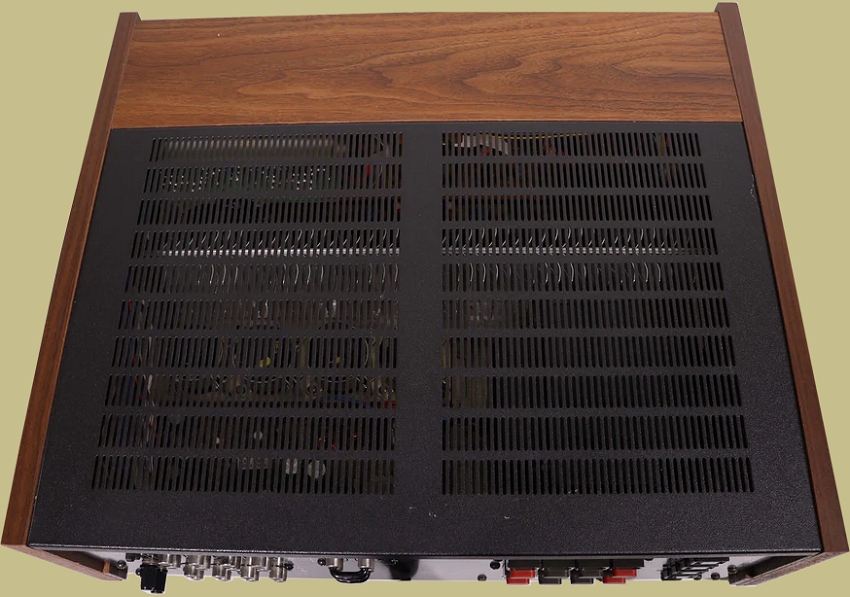
The construction quality of the SA-8800 is excellent. Much of it was hand-installed and soldered. Signal paths and power leads were arranged to prevent interference, with grounding points strategically placed for better sound quality. Power RETs and emitter resistors use pure copper leads. Copper is also used in the transistor mount frames. The use of “Twist-Wire” leads help prevent phono hum in the input path and high-frequency instability in the output path. Overall a well constructed Amplifier. It is also easy to work on. One drawback though is the fluoroscan display which, if it goes bad, is very difficult to find a replacement for today.
Heat Sink
The amplifier uses thin-sliced “skived” heat sinks with curved fins arranged in a “T” formation, reinforcing both the sink and chassis. This design improves heat dissipation by up to 50% compared to conventional designs while significantly reducing weight.
Other Features
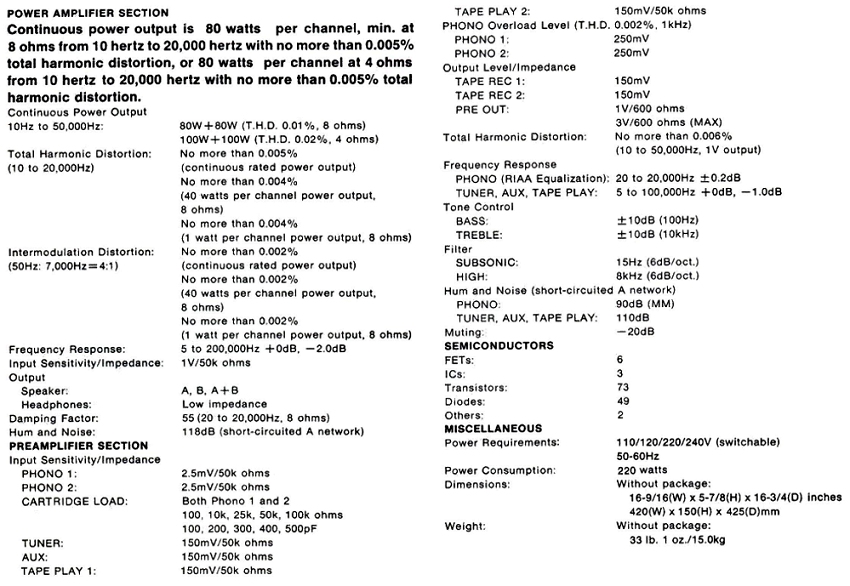
Phono Interference Filter – There is a rear panel switch for both Phono inputs which allows elimination of radio and other interference sources.
Pre/Main Terminals – There are separate terminals for PREAMP OUT and POWER AMP IN which provides flexibility in system configuration.
Specifications
- Power output: 80 watts per channel into 8Ω (stereo)
- Frequency response: 5Hz to 100kHz
- Total harmonic distortion: 0.05%
- Damping factor: 55
- Input sensitivity: 2.5mV (MM), 150mV (line)
- Signal to noise ratio: 90dB (MM), 110dB (line)
- Output: 150mV (line), 1V (Pre out)
- Semiconductors: 3 x IC, 6 x FET, 73 x transistors, 49 x diodes
- Dimensions: 16 9/16″ x 5 7/8″ x 16 3/4″ (453 x 155 x 425mm)
- Weight: 33 lbs (15.6kg)
- Year: 1979
Rear Panel
There are a number of features on the rear panel of the SA-8800.
The Phono Interference Filter switch attenuates radio frequency interference from external electronic devices during record playback. When this switch is ON and the cartridge load resistance is set to 100 ohms, volume will be reduced.
There are two Phono jacks to connect turntables, a tuner jack, an Aux jack for a phone or CD player and 2 Tape jacks to hook up tape decks.
Pre/Power Amplifier Connectors: A removable connector bar or jumper allows separation of preamplifier and power amplifier sections. The jumper must be connected for normal operation; no sound will be heard if disconnected.
The SA-8800 has terminals for two pairs of speakers, two ground terminals to connect turntable ground wires. There are also two switched and two unswitched power outlets for connecting other stereo components (turntable, tuner, tape deck, etc.).
Reviews
“Great Amp, unique design and classic look with clean performance.”
“Sounds amazing. Powerful enough with clean punchy dynamic sound.”
“Plenty of clarity and headroom and power to spare. If you find one in decent to excellent condition – jump on it!”
“Very nice looking. Sound quality average – nothing special.”
“I love my SA-8800.”
Summary
Overall, the Pioneer SA-8800 is an excellent amplifier. It has a classic vintage look along with the cool fluorescent meter display. At 80 watts per channel it has enough power for most situations and connections for turntables, CD players, and tape decks make it very flexible. They are definitely worth acquiring in good working condition and as long as the fluorescent meters work properly.