The late 1970s was a turning point for Yamaha. They had made a name for themselves with the legendary B-1 and B-2 VFET amplifiers, but things were changing. The “VFET” era was cooling off and the tech was moving toward “High FT” (high-frequency transition). Introduced in 1979, the Yamaha M-2 amplifier was the powerhouse answer to this new era of high-speed, low-distortion audio.
History and Development
The Yamaha M-2 hit the market in 1979 with a retail price of $1,200 alongside its smaller sibling, the M-4 ($650), and was intended to be paired with the C-2a preamplifier. While it had a relatively short production run until 1981, eventually being replaced by the M-50 and M-70 series in 1983, the M-2 may be the peak of Yamaha’s “Natural Sound” philosophy. Interestingly, while it was a consumer product, its engineering was heavily influenced by Yamaha’s P-series professional amplifiers used in recording studios and DJ racks.
Front Panel Controls
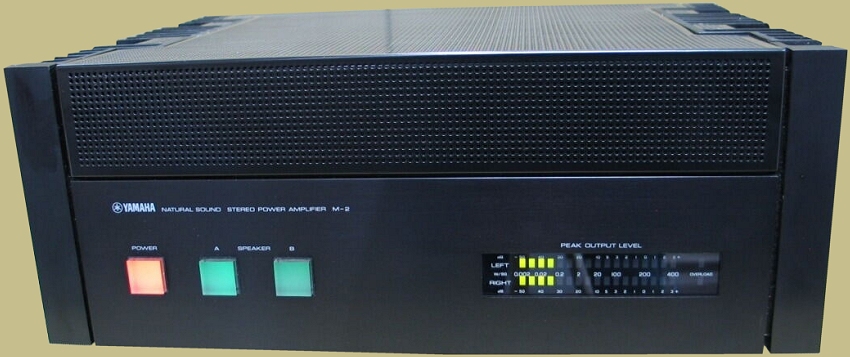
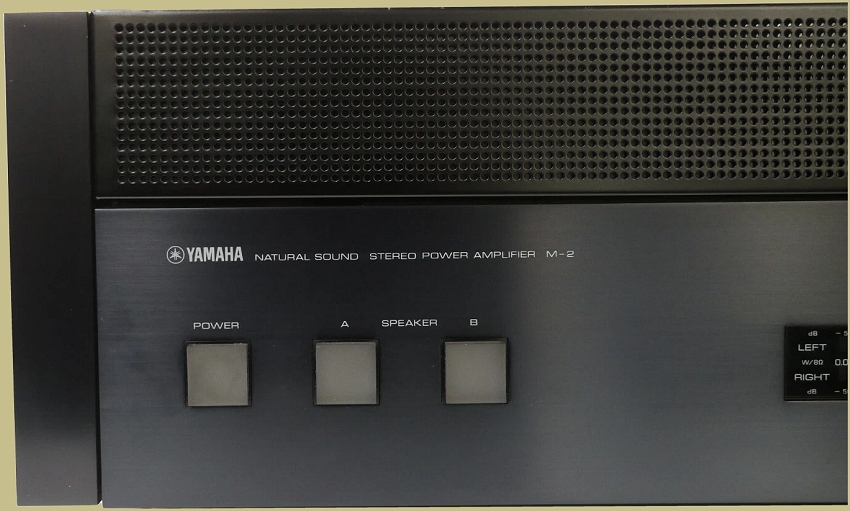
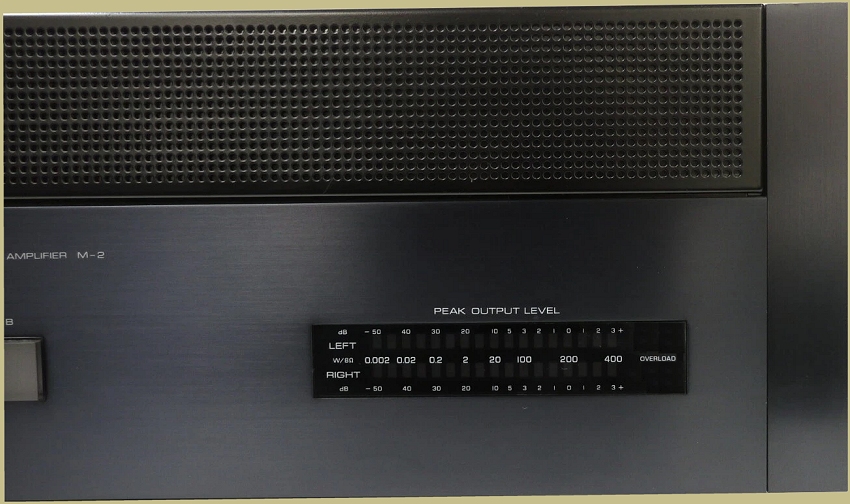
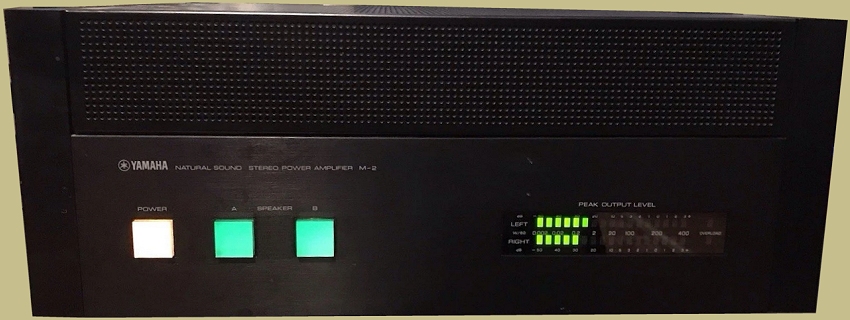
The M-2 has a visually striking tech aesthetic with its all black metal case and minimalist front panel. The front panel features:
- Dual LED Peak Level Meters: These bar graphs provide real-time output monitoring, with each segment representing a +5dB increment alongside peak wattage readings.
- Illuminated Switches: The power button glows amber, while the dual speaker selectors (A and B) glow green.
- Protection Indicators: An LED overload indicator warns the user if the amplifier is being pushed beyond its safe operating limits.
Amplifier Specifications
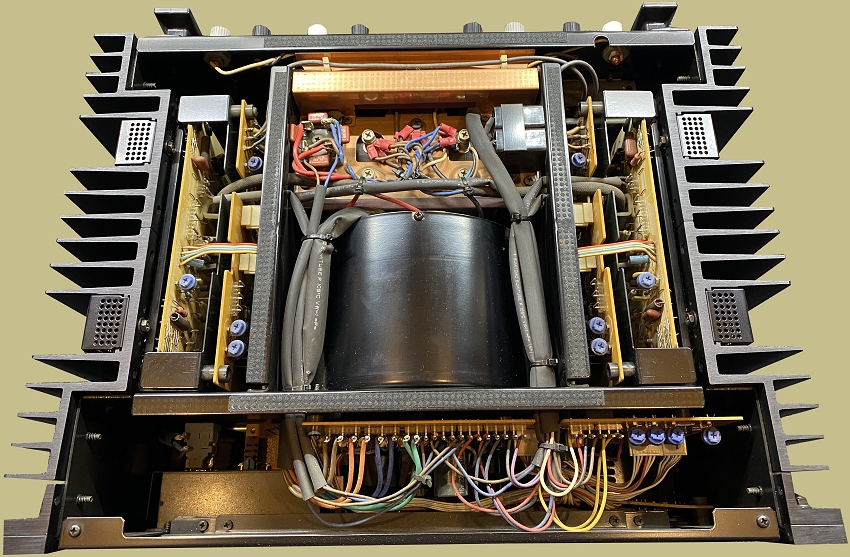
On paper, the M-2 is an absolute titan. It was designed as a DC power amplifier featuring a dual FET input stage with a cascode bootstrap circuit. Look at the size of that transformer!
- Continuous Power: 240 Watts per channel into 8 ohms (20–20,000 Hz). 380 watts per channel into 4 ohms.
- Dynamic Peak Output reaches 400 watts per channel into 8 ohms.
- Total Harmonic Distortion (THD): An incredibly low 0.005%.
- Power Bandwidth: 10–100,000 Hz (at half rated power).
- Output Topology: Three-stage emitter-follower complementary triple push-pull DC circuitry.
- Output Devices: Yamaha utilized three parallel-connected pairs of Toshiba transistors (2SC2461 and 2SA1051) per channel to ensure linearity and low distortion even at low signal levels.
- Frequency Response: 1 Hz – 100 kHz (±0.5 dB)
- Signal-to-Noise Ratio: 127 dB (IHF-A)
- Damping Factor: 200 (8 ohms, 1 kHz)
- Stereo Separation: 100 dB (1 kHz), 80 dB (20 kHz)
- Input Sensitivity: 1.48 V / 25 kΩ
- Power Consumption: Up to 1500 W
The M-2 runs hot so good ventilation is a must. Stacking other equipment on top of it is probably not a good idea. It’s also recommended to ensure the idle current and DC offset are adjusted according to the service manual to prevent premature component wear. Fortunately, because it uses discrete components rather than custom integrated circuits, a skilled technician can keep an M-2 running indefinitely.
Heatsinks
The Yamaha M-2 amplifier has two huge heatsinks on either side of the case which are essential for dissipating the heat generated by its 240-watt-per-channel output. They’re actually part of the amp’s structural frame, which makes taking the amp apart for cleaning or service a bit of a project. Also, the thermal paste between the transistors and the metal can dry out over time. It’s always a smart move to refresh that compound during a service to make sure this beast of an amp stays cool.
Other Features
- Gold-plated RCA inputs
- Gold-plated speaker outputs
- 2.5mm pure copper bussing
- Phase-corrected polystyrene caps
- Linear Transfer bias switching
- Ground termination
- AC+DC inputs
Construction Quality
Weighing in at 21kg (roughly 46 lbs), the M-2 is built like a tank. Its dimensions are: 43.5W x 18.3H x 36.2D cm (17.13 × 7.20 × 14.25 inches). The internal architecture tightly organized:
- Power Supply: A massive toroidal transformer paired with two high-capacity 44,000µF electrolytic capacitors.
- Premium Components: Aside from the large filter caps, nearly all other capacitors are high-quality Mylar or polystyrene.
- The Copper Bar: The internal earthing bar is made of pure copper to provide an ultra-low impedance connection, which stabilizes operation and reduces intermodulation distortion.
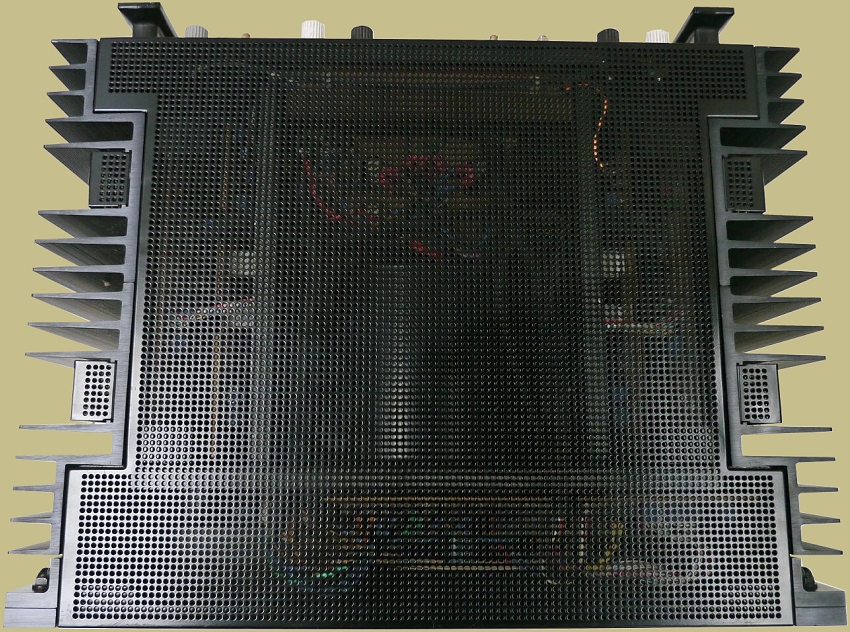
- Aesthetic Cues: The upper third of the chassis features a perforated metal cover.
Rear Panel Features
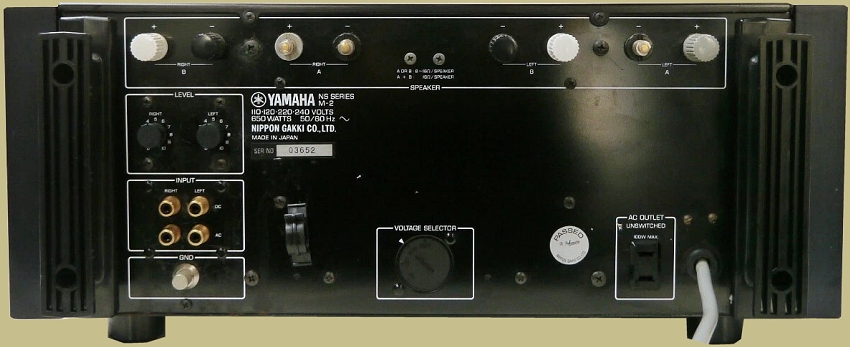
The rear panel has a number of features and controls:
- Input Level Controls: Separate Left and Right variable pots allow you to adjust the gain, which is useful for matching the amp to different preamplifiers. It’s a little strange to have these controls at the back of the amp but it does make for a cleaner front I guess.
- AC/DC Input Switch: Allows the user to choose between AC-coupled or direct-coupled (DC) operation.
- Speaker Terminals: Supports two pairs of speakers, though the connectors themselves are often cited as a weak point by modern standards.
Pros and Cons
While the M-2 is quite a feat of engineering, it isn’t without its minor flaws. Here are the pros and cons of the amp.
Pros:
- Massive Power: At 240W per channel, it can drive almost any speaker with ease.
- Efficient Cooling: The large external heatsinks are mounted outside the main cabinet for maximum thermal dissipation.
- Dynamic Sound: Known for being powerful, punchy, and “fun” to listen to.
- Serviceability: Unlike some vintage gear, the M-2 contains no unobtainable semiconductors so it can be easily repaired.
Cons:
- Heat Issues: The M-2 runs very warm. Heat is definitely the enemy here, so poor ventilation can lead to failure.
- Ergonomics: The input level controls are on the back, making them hard to reach if the unit is in a rack.
- Maintenance Access: The structural design uses the top and bottom panels for support, so a lot of screws have to be removed just to change something like the internal fuse.
- Fragile Lighting: The clear bulbs use colored grommets that tend to burn out over time.
Reviews
- “Amazing power amp. Musical and robust enough to power most any power hungry speaker.”
- “I am completely blown away by the sound stage! What a wonderful sounding vintage amplifier!”
- “The personification of a great amp.”
- “I’ve had one of these for 35 years now and love it.”
Why Buy a Yamaha M-2?
The Yamaha M-2 is a “sleeper” powerhouse. While it lacks the cult-like status of the VFET B-1, it offers significantly more power and better reliability for a modern listener. You should consider the M-2 if you want almost limitless headroom and a clean, dynamic sound that doesn’t color the music. It’s a perfect choice for someone who appreciates the “overbuilt” Japanese engineering of the late 70s and wants an amplifier that can handle demanding, low-efficiency speakers without breaking a sweat.